
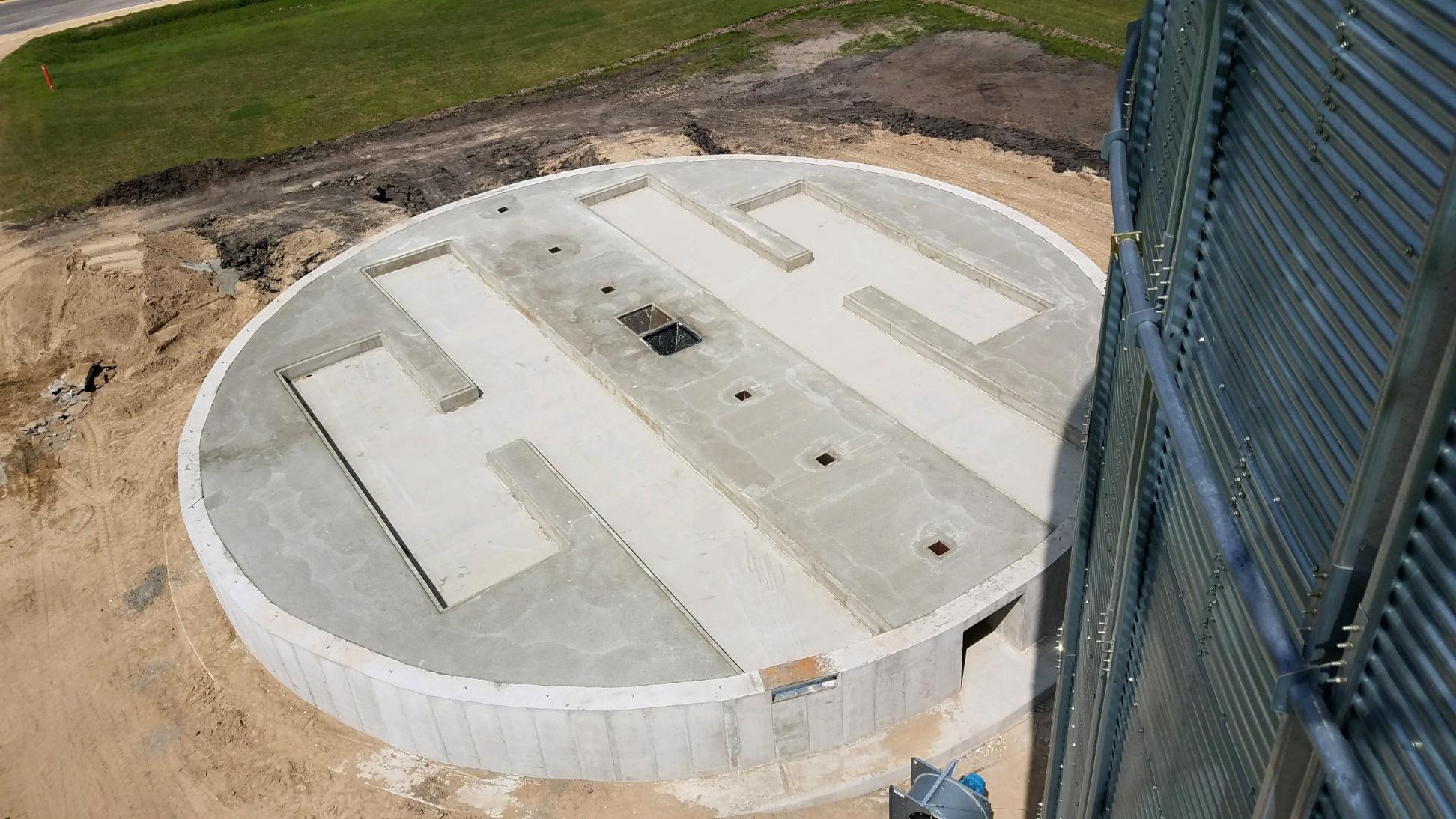
At Agri-Systems we know that when investing in grain storage, what’s beneath the bin is just as important as what goes in it. Two very critical elements of any grain bin project are the bearing strength of the soil and the foundation on which the bin is built on. In today’s topic, we will dive into details about foundations.
Two of the most used foundation types in grain bin construction are stem wall (inverted T) and donut (ring-shaped or traditional slab on grade) foundations. Each has its place, but their differences become especially significant when you consider long-term equipment integration, equipment capacities, load demands, and site conditions.
Let’s break down the critical differences—and why the right foundation can mean the difference between decades of reliable use or costly retrofits.
What Are Stem Wall and Donut Foundations?
Stem wall foundations are constructed with a poured concrete footing above or below grade and a vertical wall that rises above it. The bin rests atop the wall, and most often there is a poured concrete tunnel that goes through the center for access and equipment. The rest of the area is backfilled and compacted with granular material, and then a cap or slab is poured on top. This foundation essentially creates a structural “box” with elevation and flexibility.
Donut foundations, on the other hand, involve pouring a circular footing that is centered on the the bin’s diameter. The center is typically backfilled with compacted gravel and then a 6” concrete floor is poured. The bin sits directly on the ring, which supports its weight without raising it above grade.
If designed correctly for the loading of the bin and the site specific soil bearing capacity, both support vertical loads effectively. The biggest advantages to the stem wall foundation are the increased height for maintenance and access to equipment.
Foundation Footings: Hidden but Critical
Regardless of the style, every grain bin foundation starts with footings—and they deserve special attention. These are not just slabs of concrete; they are engineered components that transfer the bin’s tremendous vertical load into the earth.
- For stem walls, footings must also support the vertical wall structure and any live loads from conveyors, sweep augers, and equipment mounted below the bin. They’re often deeper and wider to resist frost heave and shifting, especially in northern climates.
- In donut foundations, the footings form the only structural element. Since there is no wall, they bear the full brunt of weight and weather, and must be carefully reinforced to prevent movement or cracking over time.
It is important to understand the that the soil bearing strength must be assessed to accurately design a foundation. Since grain bins can literally be storing 50+ Million pounds of grain, this is absolutelty critical. Projects with bins over 100,000 bushels or that have a large height to diameter ratio need to have soil borings to assess the soil strength. From this information, the geotechnical engineers can determine what an achievable soil bearing strength is with soil correction. With this data, we can then design the structural foundation. (we will address soil correction options in a later blog)
Equipment Integration: Where Stem Walls Shine
One of the most practical advantages of a stem wall foundation is the ability to integrate unload equipment directly into the bin base.
Want a drag conveyor or belt conveyor that runs under the entire bin? Need large capacity bin unloading equipment? A stem wall lets you install that beneath the bin floor—keeping it dry, protected, and easily accessible.
Or maybe you want a bin foundation raised up 5 or 6 feet so the bin unload that is under the aeration floor can go straight out to another piece of equipment. Another great opportunity for a stemwall (that wouldn’t need a tunnel in this case). We often see this for wet bins discharging directly into a bucket elevator or grain pump.
With a donut foundation, most bins would have somewhere from a 16” to 24” thick footing. As the bin gets bigger with more loading, you typically see the footing get wider (for soil loading) but typically not much thicker. This minimal height does not allow good access or height for bin unloading equipment to discharge into other equipment. Also, without the stem wall all the unloading equipment has to go on top of the foundation, and usually under the aeration floor. So there is no access to the equipment when the bin is full. And the size of the equipment is limited to what fits under a standard aeration floor which is often around 12”.
Long-Term Considerations: Durability and Flexibility
Choosing a foundation isn’t just about what works today—it’s about what will keep working 20 years down the line.
Stem wall foundations tend to cost more upfront due to additional labor and formwork, excavation, and concrete volume, but they offer longer-term resilience. Equipment remains more accessible, structural integrity is easier to maintain, and the system is more adaptable to future upgrades.
Donut foundations may be less expensive and faster to build, especially for smaller bins, but they can limit future adaptability. Adding under-bin conveyors or sumps later may require extensive excavation or foundation modification—not to mention the risk of disturbing a loaded bin.
Final Thoughts
If you’re building for the long haul—especially for bins 60′ or larger, or for high use bins such as working or wet bins—a stem wall foundation is worth the investment. It provides a more robust platform, protects your unload equipment, and gives you flexibility for future changes.
On the other hand, if you’re looking for a cost-effective, quick-to-install solution for smaller bins, a donut foundation may serve you well, provided unloading can be handled externally or manually.
In the end, the best foundation isn’t just the one that holds the bin up—it’s the one that keeps your operation efficient, safe, and scalable. Call Agri-Systems today so we can talk through the right choice for your operation.
