

Grain does not stop changing after harvest. Temperature shifts, trapped moisture, and stale air inside a bin can turn a healthy crop into a costly loss within weeks. A grain bin aeration system is the equipment that prevents this from happening. It moves air through stored grain to control temperature and keep moisture levels stable. Without aeration, even properly dried grain can develop hot spots, mold growth, and insect problems that reduce its market value.
Farms across Minnesota, Wisconsin, Iowa, and the Dakotas rely on aeration systems to protect their corn, soybeans, and wheat through every storage season. This guide explains how these systems work, what components they include, and how to choose the right setup for your operation.
What Is Grain Bin Aeration?
Grain bin aeration is the process of forcing air through stored grain to manage temperature and prevent spoilage. The system uses fans to push or pull outside air through the grain mass inside the bin. This airflow equalizes the temperature from top to bottom, which stops moisture from migrating to cold surfaces where it causes condensation and mold.
Aeration also slows insect activity because most stored grain pests cannot reproduce when temperatures drop below 50 to 60 degrees Fahrenheit. The goal of aeration is not to remove large amounts of moisture. It is to maintain uniform conditions inside the bin so the grain stays safe until it is sold or used.

Aeration vs. Grain Drying
Aeration and grain drying are not the same thing. A grain dryer uses heated air at high airflow rates, often above 1 CFM per bushel, to remove significant moisture from wet grain before storage. Aeration uses much lower airflow rates, typically between 0.1 and 0.5 CFM per bushel, and relies on ambient air to cool the grain and maintain stable conditions. A small amount of moisture may leave the grain during aeration because cooler air holds less humidity. However, aeration should never be treated as a substitute for proper drying. Grain that goes into the bin too wet needs a dryer first, not just aeration fans.
How Does a Grain Bin Aeration System Work?
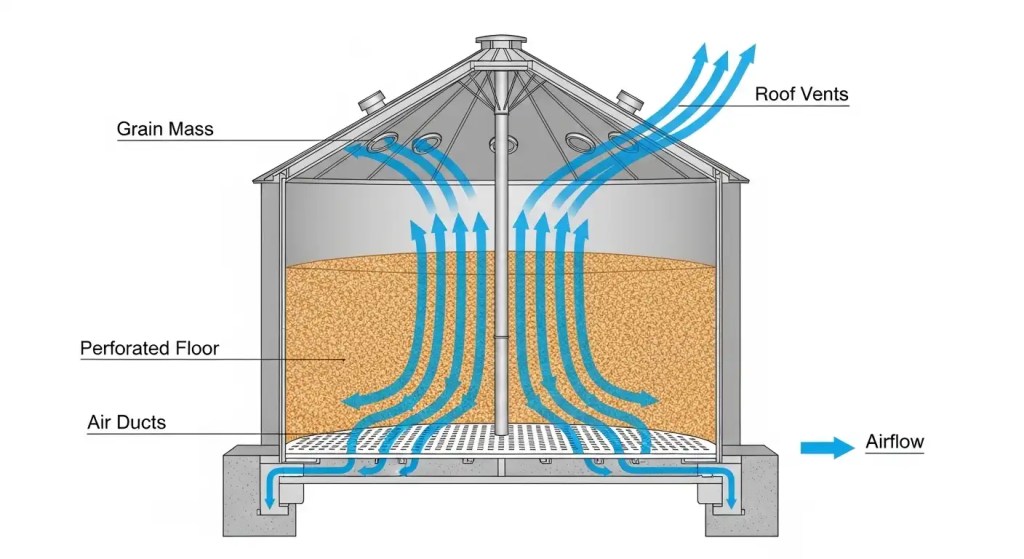
An aeration system works by creating a controlled path for air to travel through the entire grain mass. Fans mounted on the outside of the bin push air into a plenum or duct system beneath the grain. That air travels upward through the kernels, absorbing heat and small amounts of moisture along the way. It exits through roof vents and exhaust openings at the top of the bin.
As this process continues, a cooling front moves through the grain from bottom to top. The front needs to pass completely through the bin before the cycle is finished. Running the fans long enough to complete a full cycle is one of the most important parts of aeration management. Stopping the fans too early leaves warm grain at the top, which creates the exact temperature differences that cause spoilage.
Pressure Airflow vs. Suction Airflow
There are two ways to move air through a grain bin. Pressure (positive) airflow pushes air upward from the bottom. Suction (negative) airflow pulls air downward from the top. Most Midwest farms use pressure airflow because it delivers more consistent results. Fans push more air volume when working against pressure, and the cooling progress is easier to monitor at the top of the bin.
Pressure systems also eliminate the risk of roof collapse that can happen when suction fans create a vacuum inside the bin during cold weather. Suction airflow has one advantage in certain situations. It reduces roof condensation when cooling warm grain during cold months because the moist air exits at the bottom rather than hitting a cold roof. However, pressure systems remain the standard recommendation for most farm storage applications.
Key Components of a Grain Bin Aeration System
A complete grain bin aeration system includes several components that work together to deliver uniform airflow. Each part has a specific job. If any part is missing or undersized, the whole system suffers.
Aeration Fans
Fans are the power source of the system. They are mounted on the bin wall or transition and generate the airflow measured in CFM (cubic feet per minute). Key points about aeration fans:
● Available in axial and centrifugal designs depending on bin depth and crop type
● Sized based on bin capacity and target CFM per bushel rate
● Must be matched to static pressure created by the grain depth and floor system
Aeration Floor or Duct System
The aeration floor or duct system distributes air evenly across the base of the bin. There are two main options:
● Fully perforated floor: provides the most uniform airflow and is the best option for both aeration and in-bin drying
● Round or half-round duct tubes: a more affordable option that works well for bins that only need aeration
Roof Vents and Exhaust Openings
Roof vents and exhaust fans allow the used air to escape from the top of the bin. Without proper exhaust, pressure builds inside the bin and reduces airflow. Important considerations:
● Vents must be sized to match fan output so air moves freely through the bin
● Blocked or undersized vents are one of the most common causes of poor aeration results
Temperature Monitoring Cables
Temperature monitoring cables are sensors placed inside the bin that track grain temperature at multiple depths. These cables help farmers know when a cooling cycle is complete and detect hot spots before they become a problem. Benefits include:
● Real-time visibility into grain conditions at multiple heights inside the bin
● Early detection of hot spots before mold or insect activity develops
● Confirmation that a full cooling cycle has passed through the entire grain mass
How These Components Work Together
Each part of the aeration system depends on the others. A powerful fan cannot deliver results if the floor or duct system does not distribute air evenly. A perfect floor system is useless if the roof vents are blocked or undersized. And running any system without temperature monitoring means guessing when to start and stop the fans, which leads to wasted energy or incomplete cooling cycles.
A grain bin monitoring system ties everything together by giving farmers real-time data on what is happening inside the bin. The best aeration results come from farms that treat the system as a complete package rather than installing individual parts without a plan.

Axial Fans vs. Centrifugal Fans
The two main types of aeration fans are axial (vane axial) fans and centrifugal fans. Choosing the right type depends on your bin depth, crop type, and floor system. Here is how they compare.
Axial (Vane Axial) Fans
Axial fans move large volumes of air at lower static pressures. They work best in shorter bins with shallow grain depths.
● Best for bins with grain depths under 20 to 25 feet
● Lower upfront cost and less energy use when bin resistance is low
● Common on smaller farm bins with moderate grain depths
Centrifugal Fans
Centrifugal fans generate higher static pressure and are the better choice for taller bins and deeper grain.
● Recommended when grain depth exceeds 25 feet or when a fully perforated floor adds resistance
● More reliable when static pressure shifts due to uneven grain packing or high fine material levels
● Standard choice for commercial operations that want consistent performance across all bins
When to Run Your Aeration Fans
Aeration is not a one-time event. Proper grain storage management requires running fans at specific times throughout the year based on seasonal temperatures. Here is what to do in each season.
Fall Cooling: September Through December
The goal is to bring grain temperature down to 25 to 35 degrees Fahrenheit before winter sets in.
● Start fans as soon as grain enters the bin
● Run continuously during cool weather until the full cooling front passes through the bin
● Do not stop fans early. Warm grain left at the top causes the exact temperature differences that lead to spoilage
Winter Holding: December Through March
The focus shifts to maintaining stable conditions through the cold months.
● Cover fans when not running. Cold air leaking through idle fans can freeze grain near the ducts
● Check grain temperatures every two weeks and run fans briefly during mild weather to keep conditions uniform
Spring Warm-Up: March Through June
The goal is to gradually warm grain to 40 to 50 degrees without shocking the grain mass.
● Run fans during fair weather when outside temperatures are about 10 degrees warmer than the grain
● Raise temperature in stages rather than all at once to avoid moisture issues at the grain surface
Summer Holding: June Through September
The goal is to keep grain between 50 and 60 degrees through the hot months.
● Run fans only during cool nights to carry heat away from the top layer of grain
● Cover fans during the day to prevent warm air from entering the bin and raising grain temperature
What Happens Without Proper Aeration?
When a grain bin has no aeration system, or when the system is not managed correctly, problems develop quickly. Here are the most common issues and how they happen.
Moisture Migration and Crusting
Warm grain in the center of the bin creates rising air currents that carry moisture upward and outward. When that moisture hits the cold grain near the roof or bin walls, it condenses. The result is a layer of wet, crusted grain on top that can mold within days.
● Condensation forms on the cold grain surface near bin walls and roof
● Surface crusting can develop within days and block airflow if aeration is started later
Hot Spots and Insect Activity
Hot spots form in areas where airflow is blocked by foreign material, broken kernels, or uneven grain packing. These pockets of warm grain become breeding grounds for mold and insects.
● Common stored grain insects include the Indian meal moth, rice weevil, and red flour beetle
● Most pests stop reproducing below 55 degrees Fahrenheit, but without aeration, interior grain can stay above 70 degrees well into winter
● Mold growth in hot spots spreads quickly and is hard to stop once it starts
Financial Losses at the Elevator
Over time, these problems reduce test weight, lower grain grade, and cost real money at the elevator.
● Dockage and grade discounts apply to grain with elevated moisture, visible mold, or insect damage
● In severe cases, entire bins can become unsalvageable and the grain has no market value

How to Choose the Right Aeration System for Your Bin?
Choosing the right aeration system starts with understanding your bin and your storage goals. There is no one-size-fits-all answer, but a few key factors guide the decision for every farm.
Key Factors That Affect System Selection
The following factors determine which fan size, floor type, and airflow rate your bin needs:
● Bin diameter and total bushel capacity
● Grain depth, which drives static pressure requirements
● Crop type (corn creates less resistance than wheat or soybeans)
● Local climate and the length of your storage season
● Whether you plan to air dry in the bin or use aeration only for temperature management
How to Calculate the Airflow You Need?
A minimum airflow rate of 0.1 CFM per bushel is the standard recommendation for on-farm grain storage. Many experienced operators aim for 0.2 to 0.5 CFM per bushel because higher airflow rates complete cooling cycles faster and give more flexibility when storing grain at slightly higher moisture levels.
● Multiply bin capacity in bushels by your target CFM per bushel rate to get total airflow needed
● That total CFM number tells you the minimum fan size required for your bin
● Account for static pressure, which increases with grain depth and changes by crop type
● The floor, roof vents, and monitoring equipment all need to match the fan and bin size. A system undersized in any one area limits the performance of every other component
Agri-Systems Designs and Installs Complete Aeration Systems
Agri-Systems has been helping Midwest farmers plan, build, and maintain grain storage systems for decades. Our services cover everything your operation needs, from grain bin installation and grain bin conditioning to aeration system design, bin monitoring setup, and ongoing storage management support. Our team sizes every system to your bin, your crop type, and your storage goals. Whether you are breaking ground on a new bin or upgrading an existing one, Agri-Systems handles the full project from the first bolt to the final inspection. Contact us today for a quote on a complete grain storage system designed for your operation.
Frequently Asked Questions
What is the recommended CFM per bushel for grain bin aeration?
Minimum 0.1 CFM per bushel for on-farm storage. Most operators target 0.2 to 0.5 CFM for faster cooling and more flexibility.
Can grain bin aeration replace a grain dryer?
No. Aeration manages temperature but does not dry wet grain. Grain above safe moisture levels needs a dedicated grain dryer before it goes into the bin.
How often should I run my aeration fans?
It depends on the season. Run continuously during fall cooling until the front passes through. Run briefly during mild weather in winter and summer. Check grain temps every two weeks.
Do hopper-bottom bins need aeration?
Yes. Hopper-bottom bins are just as vulnerable to moisture and temperature problems as flat-bottom bins. Aeration kits sized for the cone-shaped bottom are available for every bin that holds grain more than a few weeks.
How much does a grain bin aeration system cost?
Costs vary by bin size, fan type, and floor system. A basic fan for a small bin can run a few hundred dollars. A full system for a large commercial bin can reach several thousand. Contact Agri-Systems for a quote.


