

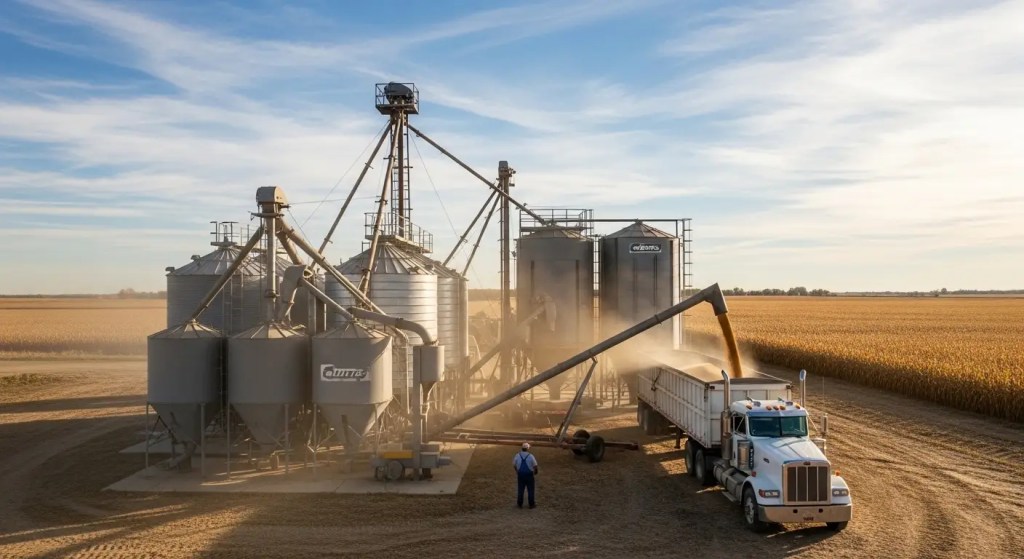
Grain does not always come out of the field at the right moisture level for safe storage. When it is too wet, it can create problems in the bin, including mold, hot spots, spoilage, and lower grain quality.
A grain dryer helps solve that problem by removing extra moisture before the crop is stored. It uses controlled heat and airflow to pull moisture out of the grain. The humid air leaves the dryer, the grain is cooled, and then it moves to storage.
In this guide, we’ll explain how a grain dryer works, what parts are involved, and how the dryer connects with the rest of a grain handling system.
What Is a Grain Dryer?
A grain dryer removes moisture from harvested grain before it goes into the bin. Most crops come off the field above the safe moisture level for storage. Corn typically comes in at 18% to 25% moisture. Soybeans often run between 13% and 18%. Neither is safe for long-term storage at those levels.
A grain dryer brings moisture down to a target level. Corn held through winter is generally stored at 15.5%. Corn held into summer should reach 13% to 14%. Soybeans are typically stored at 13% or below. The right target depends on your storage timeline and buyer requirements.
Grain dryers work for corn, soybeans, wheat, and other small grains. The right dryer depends on harvest volume, crop type, wet holding capacity, and bin layout.
The Science Behind Grain Drying
How Moisture Moves Inside a Kernel
Every kernel holds moisture inside. When heat is applied, that moisture migrates outward toward the surface. Too much heat dries the outer layer faster than the interior can follow, creating stress cracks that reduce test weight and market value.
The Role of Heat and Airflow
Heat moves moisture to the surface. Airflow carries it away. Both have to work together. Without enough airflow, humid air builds up and drying stalls. Without enough heat, moisture never reaches the surface in the first place. Blocked screens, dirty grain, or a worn fan can leave wet pockets in the grain column even when temperature settings look correct.
What Is Equilibrium Moisture Content?
Grain exchanges moisture with surrounding air until both reach a balance point called Equilibrium Moisture Content (EMC). Warm, dry air pulls moisture out of grain. Cool, humid air pushes moisture in. Proper bin aeration after drying keeps grain at the target moisture through the storage period.
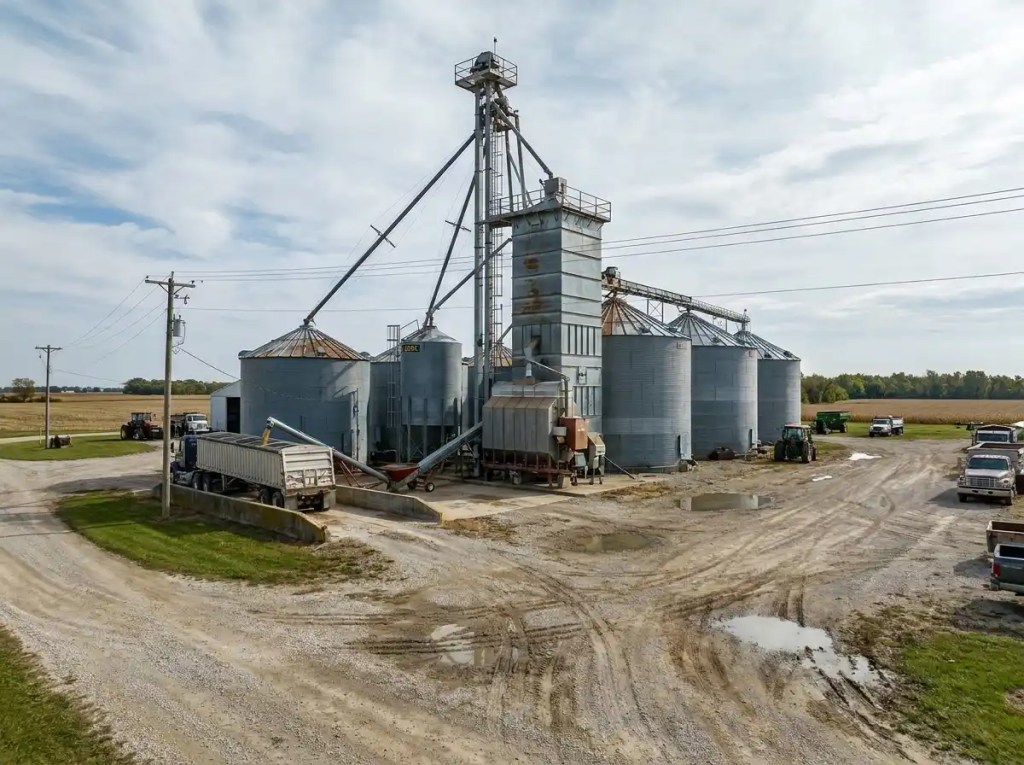
Key Parts of a Grain Dryer
Burner or Heat Source
The burner warms the air used for drying. Most Midwest dryers run on propane or natural gas. Standard dryers use 2,000 to 2,500 BTUs per pound of water removed. High-efficiency models with heat reclamation bring that down to 1,600 to 1,800 BTUs, saving 20% to 30% on fuel over a full harvest season.
Fan and Airflow System
Fans push heated air through the grain and pull humid air out. Even, consistent airflow is what makes drying uniform. An undersized or worn fan creates wet pockets where grain never reaches target moisture.
Drying Chamber or Grain Column
This is where grain sits or moves during drying. In tower dryers it is a tall vertical column. In batch dryers it is a chamber that fills before the cycle starts. Chamber design controls how evenly each kernel is exposed to heated air.
Exhaust System
Humid air has to leave the dryer continuously. If exhaust screens or vents are blocked, drying slows regardless of burner temperature. Keeping exhaust screens clean is one of the most overlooked maintenance tasks on any dryer.
Moisture Controls and Sensors
Sensors read incoming and outgoing grain moisture in real time. The control system adjusts discharge rate, burner output, or fan speed to stay on target. Calibrate sensors before every harvest season. Sensors that drift cause overdrying or underdrying across the entire harvest.
Cooling Zone
After drying, grain enters a cooling section before discharge. Hot grain put directly into a bin creates temperature gradients that drive moisture migration and mold. Cooling also firms the kernel, reducing breakage during handling.
Discharge System
Metering rolls or discharge augers control how fast dry grain exits the drying column. That speed controls how long each bushel spends in the drying zone, which is the primary adjustment for hitting target moisture consistently.
How Does a Grain Dryer Work — Step by Step
- Wet grain enters. It arrives from a receiving pit, wet holding bin, auger, conveyor, or bucket elevator. Uneven flow in means uneven drying out.
- Pre-heating where applicable. Some dryers warm grain before active drying. Seed corn must stay below 120 degrees Fahrenheit to protect germination rates.
- Active drying zone. The burner heats air and fans push it through the grain. Corn headed to an elevator typically runs at 200 to 250 degrees Fahrenheit in a continuous flow dryer.
- Moisture exhausts. Water migrates to the kernel surface, evaporates into moving air, and exits through exhaust vents. Some dryers reclaim heat from exhaust air to cut fuel use per load.
- Automatic moisture control. Sensors adjust discharge rate, burner output, or fan speed in real time to keep outgoing grain on target.
- Cooling. Ambient air brings grain temperature down. This phase must be completed before grain moves to the bin.
- Discharge to storage. Dry grain moves to the bin through augers or conveyors. Aeration fans and temperature cables in the bin continue protecting quality through storage.
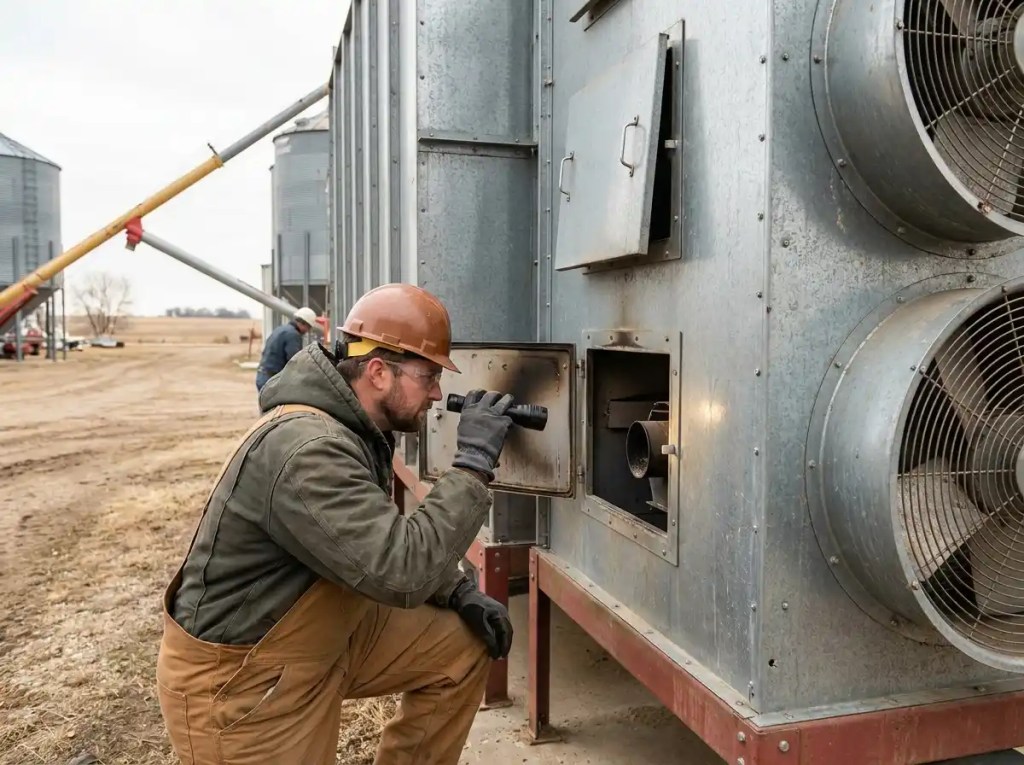
Types of Grain Dryers and How Each Works
Batch Dryers
Fills a fixed chamber, dries one load, discharges, and repeats. Good for smaller operations and sites drying multiple crop types. More hands-on than continuous systems.
Continuous Flow Dryers
Wet grain enters the top while dry grain exits the bottom continuously. Built for larger farms and commercial sites with high harvest volume. Requires wet holding bins, capable grain handling equipment, and usually three-phase power.
Tower Dryers
Grain flows down through heating and cooling zones by gravity while hot air passes through horizontally. High capacity in a compact footprint. Agri-Systems carries the Brock Meyer Energy Miser Tower Dryer and the Brock Commercial Tower Dryer.
Mixed Flow Dryers
Angled ducts alternate airflow direction so air contacts grain from multiple angles. More uniform drying, lower fuel cost, and better test weight protection than standard crossflow designs. The Brock Vector Energy Miser Mixed Flow Dryer is available through Agri-Systems.
In-Bin Drying Systems
Uses the storage bin as the drying chamber. Fans push air upward through grain stored in the bin. Slower than a dedicated dryer and depends on airflow, grain depth, and weather. Agri-Systems supplies complete in-bin drying systems for farm and commercial use.
|
Dryer Type |
Best Fit |
Main Advantage |
|
Batch dryer |
Smaller farms, multiple crops |
Flexible, lower upfront cost |
|
Continuous flow |
Larger farms, commercial sites |
High volume, lower cost per bushel |
|
Tower dryer |
High-capacity commercial sites |
Strong output, compact footprint |
|
Mixed flow dryer |
Farms prioritizing grain quality |
Uniform drying, fuel efficiency |
|
In-bin drying |
Moderate moisture, flexible timeline |
Uses existing bin infrastructure |
How to Power a Grain Dryer
Propane vs. Natural Gas
Most Midwest dryers run on propane or natural gas. Natural gas costs less per BTU where pipeline access is available. Propane is the standard for rural farm sites without a gas line. The decision usually comes down to what is already on site.
Three-Phase Power Requirements
Large continuous flow dryers require three-phase electrical service. Many rural locations only have single-phase utility power. Connecting three-phase from the utility can be expensive. Factor that into the budget before buying a large dryer.
Phase Converters for Rural Farm Sites
A rotary phase converter turns single-phase utility power into three-phase power strong enough to run a grain dryer. It is often the most cost-effective solution for farms without three-phase access. Sort out your power situation early in the planning process — it is one of the most consistently overlooked costs in dryer projects.
Conclusion
A grain dryer removes moisture using heat, airflow, and controlled grain movement. But the dryer is only one part of the system. Grain handling, wet holding, bin layout, and site design all affect how well it performs.
Agri-Systems can help with dryer selection, installation, grain handling integration, storage systems, and full-site planning. Contact Agri-Systems to build a drying system that fits your operation.
Frequently Asked Questions
Not every small farm needs its own dryer. If you harvest a smaller volume and have access to a nearby elevator or cooperative drying service, custom drying is often more cost-effective than owning equipment. As acreage and harvest volumes grow, owning a dryer gives you more control over timing, quality, and when you sell.
Grain can dry slowly using aeration fans and natural air movement, a method called natural air drying. It works well when grain comes off the field at moderate moisture and weather is consistently favorable. It is unreliable for very wet grain, cold and humid conditions, or large volumes needing fast drying during a short harvest window.
Corn held through winter is generally stored at 15.5%. Corn held into summer should reach 13% to 14%. Soybeans store at 13% or below. Wheat and small grains target 13% to 14%. Always confirm with your buyer for their specific requirements.
It depends on starting moisture, crop type, dryer size, and operating conditions. A batch dryer reducing corn from 22% to 15% can take several hours per load. A continuous flow dryer can move hundreds to thousands of bushels per hour depending on the model.
Wet grain heats up, molds, crusts, and loses market value. Elevators charge dockage fees for excess moisture. In serious cases, a bin of wet grain can become unsalvageable within weeks.
Uneven moisture in outgoing grain, longer drying times, high fuel use, grain coming out too hot, and repeated burner or fan issues are the most common signs. Either the dryer needs service or the surrounding grain handling setup is not keeping pace.


